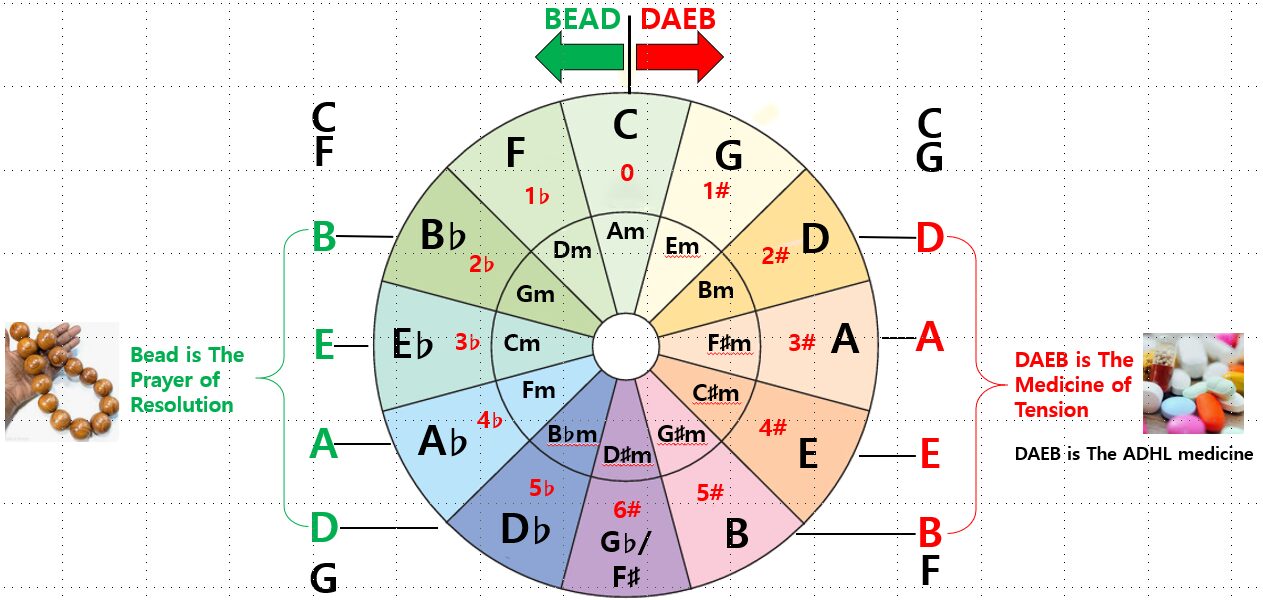
Dep–Bead Theory: A New Emotional Model of the Circle of Fifths
For centuries, musicians have used the Circle of Fifths as a visual map of keys —
a logical structure of sharps and flats, a tool for modulation and harmony.
But what if the circle is not only a chart of tonality,
but also a map of emotion — a mirror of tension and release?
That’s the idea behind the Dep–Bead Theory,
a new way to feel, not just understand, the Circle of Fifths.
This theory also provides an intuitive way to memorize the Circle of Fifths through emotional symmetry — tension and resolution.
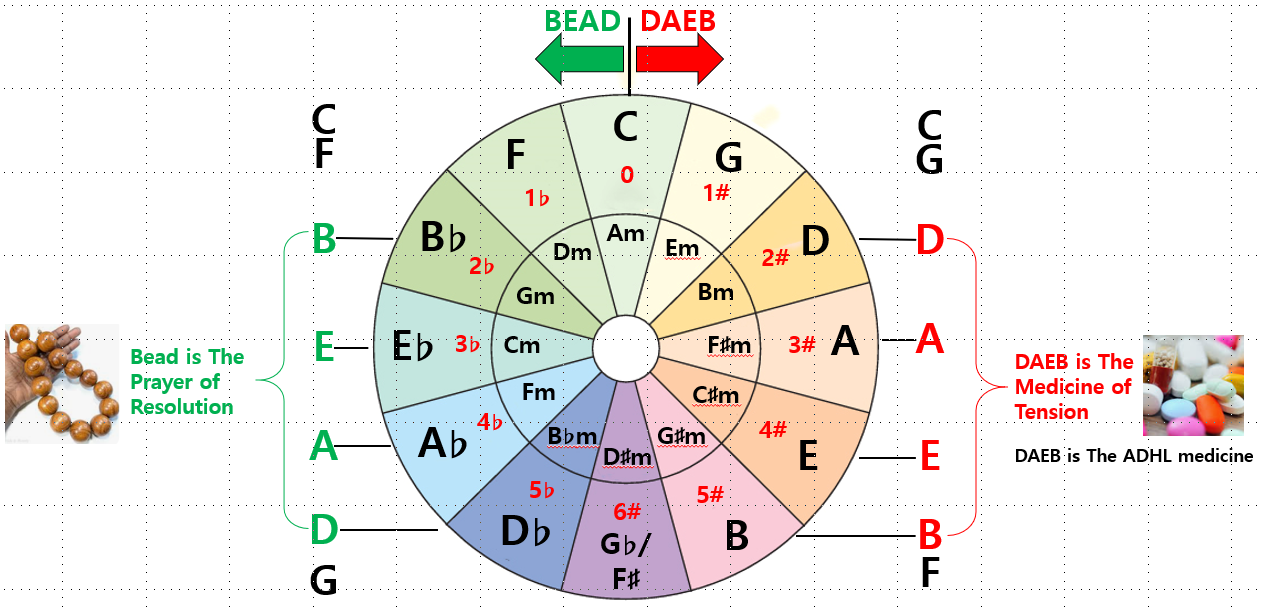
© 2025 Seokje Cho. Dep–Bead Theory: A New Emotional Model of the Circle of Fifths.
This work and all accompanying images are licensed under a
Creative Commons Attribution 4.0 International License (CC BY 4.0).
You are free to share and adapt the material, provided that proper attribution is given.
Creative Commons Attribution 4.0 International License (CC BY 4.0).
DAEB – The “Dep” Side: The Medicine of Tension
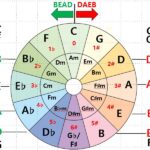
Move clockwise around the circle — D → A → E → B → F♯ → C♯ …
Each step adds a sharp, tightening the tonality, brightening the color.
This direction feels like rising energy, like taking a powerful medicine.
I call this side Dep — short for DAEB.
It represents Dominant motion, tension, drive, and awakening.
Just as medicine activates dormant cells,
DAEB awakens the harmony:
every new key is more charged, more alive, more vivid.
When your music feels stagnant,
moving through the Dep path is like injecting harmonic adrenaline —
a healing energy that restores motion and purpose.
BEAD – The “Bead” Side: The Prayer of Resolution
Now, move counterclockwise — B → E → A → D → G → C → F → B♭ → E♭ …
Each step adds a flat, softening the tonality, darkening the timbre.
The energy dissolves, returning to rest.
This is the Bead side —
named after BEAD, but also echoing the English word prayer beads.
Each chord, each key change is like rolling a bead through your fingers —
a slow, mindful motion that brings calm and release.
While Dep excites the heart, Bead quiets it.
It’s the sound of coming home.
The Emotional Symmetry
C sits in the center — perfectly balanced.
To the right, Dep (DAEB) builds tension and sharpness.
To the left, Bead (BEAD) releases tension and adds flats.
| Direction | Pattern | Symbol | Emotional Function |
|---|---|---|---|
| Right (Dep) | D–A–E–B | 💊 Medicine | Energy, Tension, Ascension |
| Left (Bead) | B–E–A–D | 🧘 Prayer Beads | Calm, Resolution, Return |
Together they form a symmetrical emotional system:
one side heals through action, the other through stillness.
Dep and Bead are not opposites — they are partners in musical balance.
“Dep awakens, Bead releases.”
Music breathes between them.
Applying the Dep–Bead Theory
-
When a song needs motion or climax → follow the Dep path (clockwise).
-
When you want resolution or closure → follow the Bead path (counterclockwise).
-
When composing or improvising → imagine yourself moving on this emotional axis:
from medicine to meditation, from drive to peace.
This way, the Circle of Fifths becomes more than theory —
it becomes a map of feeling.
Conclusion
The Dep–Bead Theory reframes the Circle of Fifths
as a living, breathing system of emotion.
Instead of memorizing sharps and flats,
you sense tension and release, energy and calm.
It’s not just about harmony —
it’s about how harmony feels.
The Circle of Fifths is not a circle of keys,
but a circle of healing.
One half is the medicine.
The other is the prayer.



Interesting points! Seeing AI like Gemini Nano Banana democratize complex image editing is huge. The cross-device accessibility is a game-changer for creators on the go – no more software headaches!
Thanks, I’ll go through it.