Introduction
The FCG central axis is the key reference for understanding the sharp and flat directions in the Circle of Fifths. In this article, we introduce a new perspective by combining the FCG central axis with the Dep–Bead Theory, making the Circle of Fifths easier to understand and remember.
The Circle of Fifths is one of the most important concepts that every musician should understand. However, many people end up memorizing the order of sharps (F-C-G-D-A-E-B) and the order of flats (B-E-A-D-G-C-F) separately, which often makes the concept feel more complicated than it really is.
To solve this problem, I previously introduced the Dep–Bead Theory and the Emotion Model as a new learning approach.
The article can be found here:
Dep–Bead Theory: A New Emotional Model of the Circle of Fifths
In this article, we take the idea one step further by introducing the concept of the FCG central axis.
When the Circle of Fifths is viewed around the FCG central axis, the sharp direction and the flat direction are no longer seen as two separate systems. Instead, they become opposite directions within the same structure, making the overall pattern much easier to understand.
In this article, we will combine the FCG central axis with the Dep–Bead structure to simplify the Circle of Fifths and provide a more systematic way to understand and memorize it.
Why Is FCG the Central Axis?
The diagram below illustrates the Circle of Fifths explained using the Dep–Bead Theory.
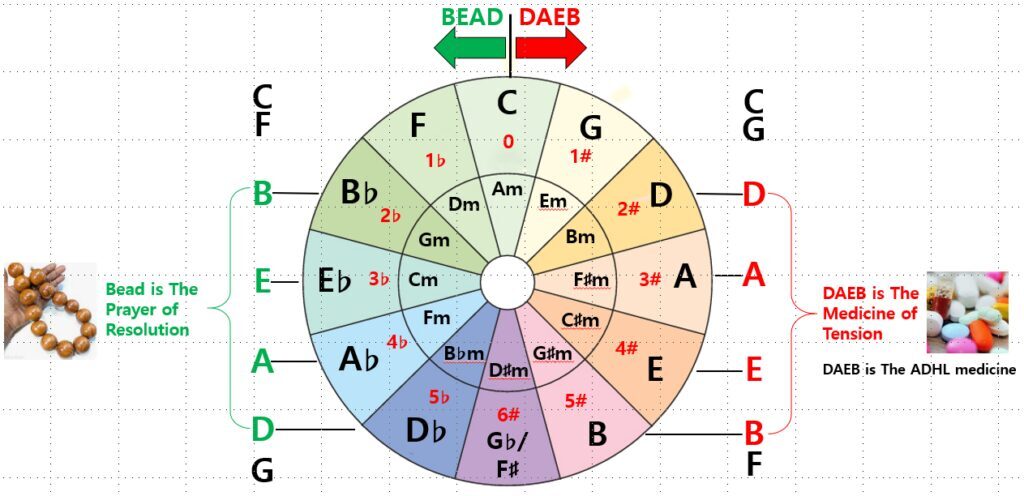
Before looking at the Dep–Bead Theory itself, let’s first examine the Circle of Fifths with C as the starting point.
In the Circle of Fifths, C Major is the only key signature that contains neither sharps (#) nor flats (♭). In other words, it serves as the fundamental reference point from which all other key signatures are derived.
If we place C at the center, F Major (1 flat) lies to the left, while G Major (1 sharp) lies to the right.
F    ←   C   →   G
♭1 0 #1- Moving one step to the left adds one flat (♭) each time.
- Moving one step to the right adds one sharp (#) each time.
Therefore, C is the reference key with no key signature, while F and G are the first keys where flats and sharps begin to appear.
This is why F–C–G becomes the central axis—it is the point where the Circle of Fifths branches into the flat side and the sharp side.
From the perspective of the Dep–Bead Theory, this FCG central axis provides a natural boundary between the BEAD (flat) side on the left and the DAEB (sharp) side on the right, revealing how the two directions develop as mirror images of one another.
Now, with FCG established as our central axis, let’s explore how the left and right sides expand according to their respective patterns.
The Dep Direction (Sharp Direction)
From the perspective of the FCG central axis, the Dep direction (the sharp direction) begins with CG and extends to the right around the Circle of Fifths.
The sequence then continues with Dep (D–A–E–B), and finally F# and C# are added to complete the entire sharp side of the Circle of Fifths.
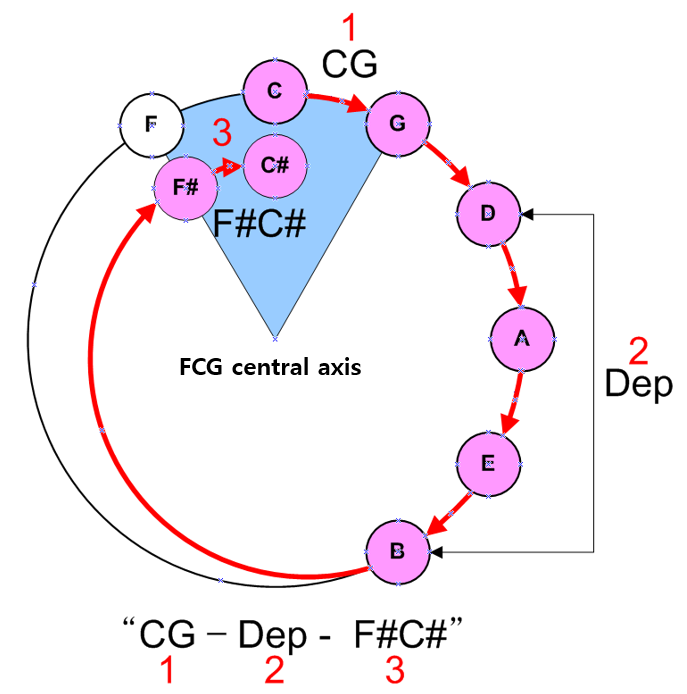
The entire sharp sequence can therefore be understood in just three steps:
CG → Dep → F#C#
- CG – The starting point of the sharp direction from the FCG central axis.
- Dep (D–A–E–B) – The main sequence of the sharp keys.
- F#C# – The final two keys that complete the sharp side.
By remembering only these three stages—CG → Dep → F#C#—you can easily reconstruct the complete order of the sharp keys without memorizing the entire sequence individually.
The Bead Direction (Flat Direction)
Viewed from the perspective of the FCG central axis, the Bead direction (the flat direction) begins with CF and extends counterclockwise around the Circle of Fifths.
It then continues through Bead (B–E–A–D), and finally Gb and Cb are added to complete the entire flat sequence.
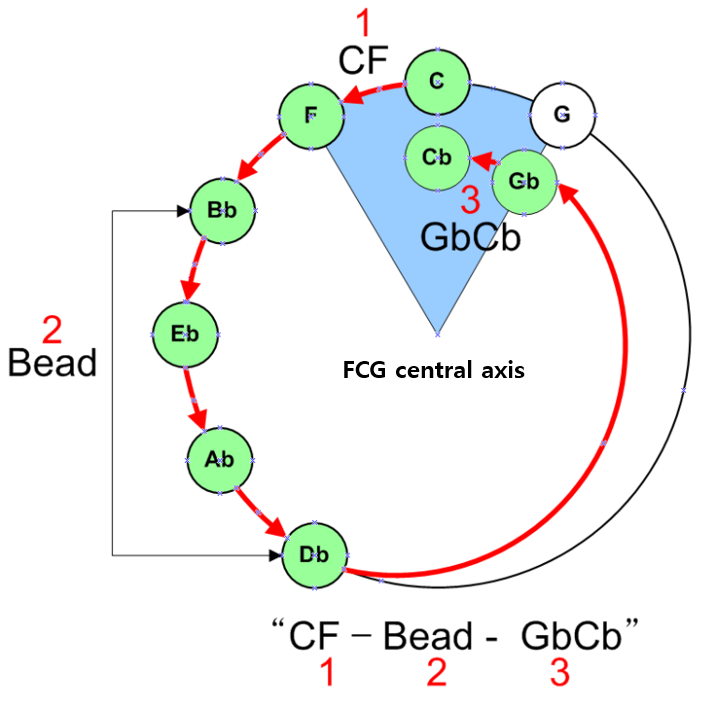
The entire flat direction can therefore be summarized in the following three stages:
CF → Bead → GbCb
- Step 1 – CF: The starting point of the flat direction from the FCG central axis.
- Step 2 – Bead (B–E–A–D): The main sequence of the flat keys.
- Step 3 – GbCb: The final two keys that complete the flat side of the Circle of Fifths.
Therefore, by remembering only these three stages—CF → Bead → GbCb—you can easily reconstruct the complete order of the flat keys.
Comparing the Dep and Bead Direction
From what we have seen so far, the structures of the two directions are remarkably similar.
| Dep Direction (Sharp) | Bead Direction (Flat) |
|---|---|
| CG | CF |
| Dep (D–A–E–B) | Bead (B–E–A–D) |
| F# · C# | Gb · Cb |
The Dep direction follows the sequence:
CG → Dep → F#C#
The Bead direction follows the sequence:
CF → Bead → GbCb
Although the two directions progress in opposite directions around the Circle of Fifths, they share the same underlying structure centered on the FCG central axis.
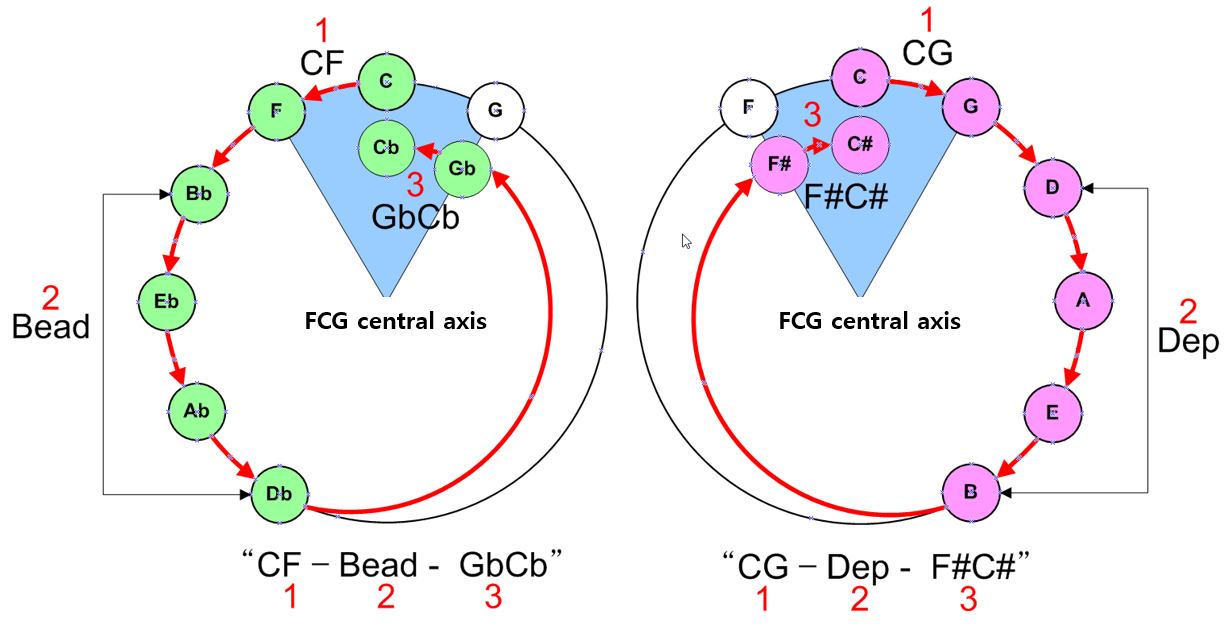
Viewed from the perspective of the FCG central axis, the sharp and flat directions are not independent systems. Instead, they are mirror-image patterns that expand in opposite directions from the same starting framework.
This symmetry is the core idea of the Dep–Bead Theory, providing a simple and systematic way to understand and memorize the Circle of Fifths.
Conclusion
In this article, we introduced a new way of looking at the Circle of Fifths by using the FCG central axis as the reference point.
From this perspective, the Dep direction can be understood as CG → Dep → F#C#, while the Bead direction follows CF → Bead → GbCb. Rather than being two separate systems, the sharp and flat directions become opposite extensions of the same underlying structure.
The two key ideas to remember are:
- FCG – The central axis of the Circle of Fifths.
- Dep–Bead – The structural pattern that expands in two opposite directions.
By remembering these two concepts together, you can understand the Circle of Fifths in a much simpler and more systematic way, making it easier to identify key signatures and remember musical keys.
When viewed through the FCG central axis, the Circle of Fifths is no longer a collection of unrelated patterns to memorize. Combined with the Dep–Bead Theory, it becomes a single, unified structure that can be reconstructed from one simple rule.
The next time you look at the Circle of Fifths, start by finding the FCG central axis, then recall the Dep and Bead patterns. You’ll find that the entire structure is much easier to understand and remember than before.