Introduction
Except for C Major, every piece of sheet music includes a Key Signature.
Key signatures use either flats (♭) or sharps (#), and can contain anywhere from one to seven accidentals. If you can identify the major key simply by looking at the key signature, you will be able to understand sheet music much more quickly.
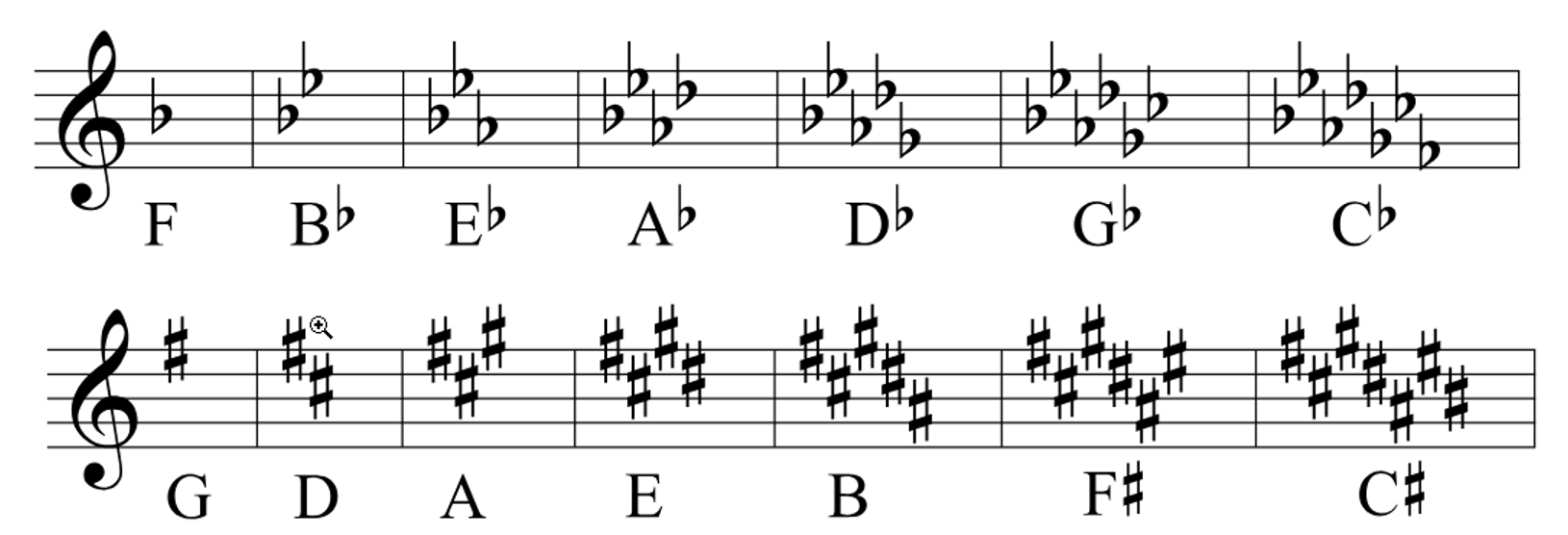
In the previous article, we introduced the Dep-Bead Theory, a simple and systematic way to memorize the order of sharp and flat key signatures.
In this article, we will use that same rule to identify the major key directly from the key signature. There is no need to learn another memorization trick. If you understand the Dep-Bead rule, you can determine the major key with just a few steps.
You can read the previous article using the link below.
How to Find Key Signatures Without Memorizing Them
Reviewing the Order of Key Signatures
In this article, we will apply the Dep-Bead Theory introduced in the previous article. Before we begin, let’s briefly review the order of flat and sharp key signatures.
Flat Key Signatures (♭)
Bb → Eb → Ab → Db → Gb → Cb → Fb
Sharp Key Signatures (#)
F# → C# → G# → D# → A# → E# → B#
These sequences are the result of applying the Dep-Bead rule explained in the previous article.
This article does not introduce a new memorization technique. As long as you remember the order of the key signatures shown above, you can identify the major key simply by looking at the key signature.
Below is the Circle of Fifths showing the order of the key signatures. In the following examples, we will use this diagram to demonstrate, step by step, how to identify the major key.
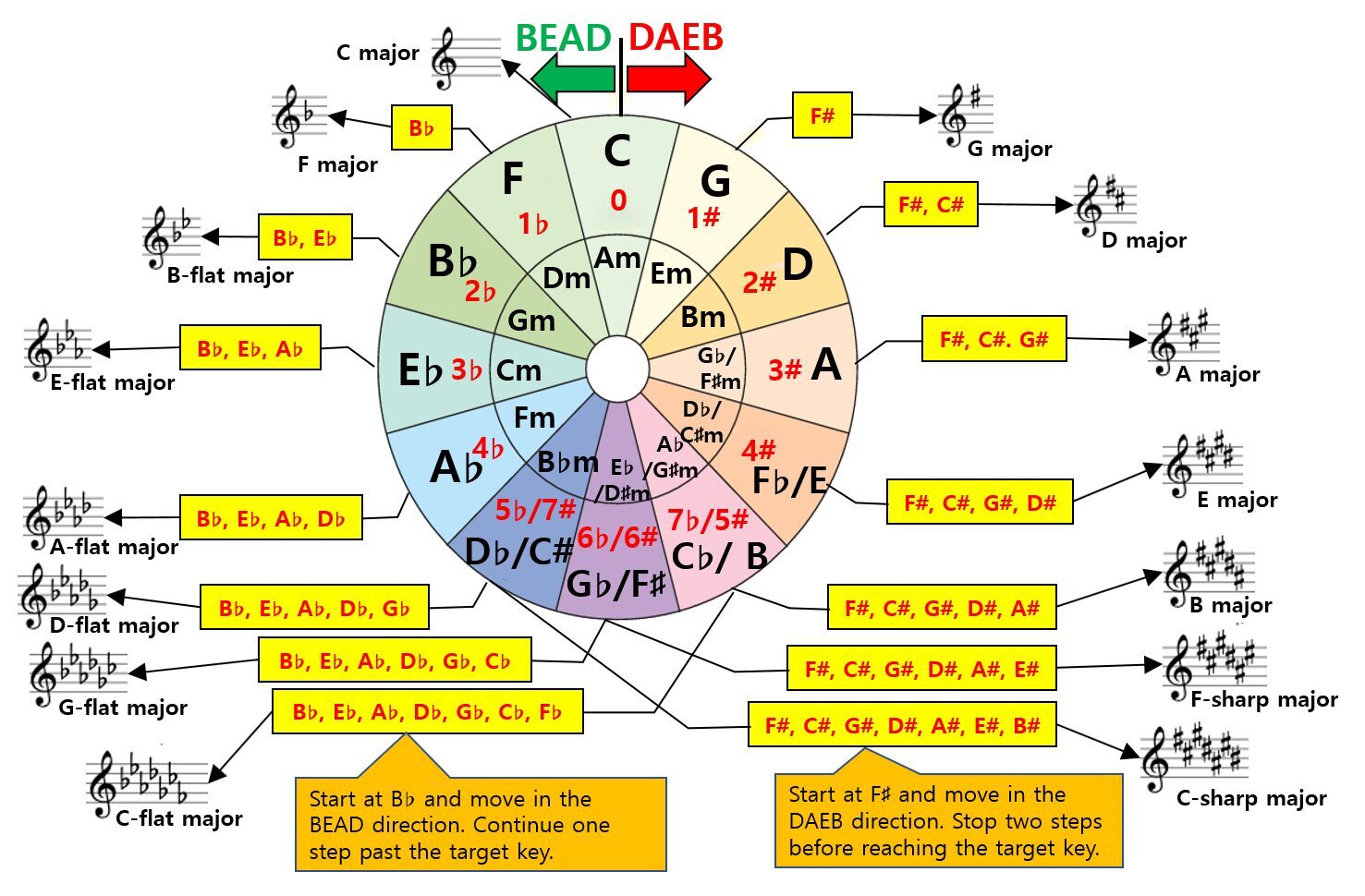
Finding Major Keys from Flat Key Signatures
Now let’s learn how to identify the major key from a flat key signature.
In the previous article, we explained flat key signatures as follows:
“Starting from B♭, the key signature includes every flat up to one step past the target key in the BEAD direction.”
In this article, we will apply this rule in reverse.
In other words,
The major key is the key located one step behind the last flat.
Let’s look at the example below.
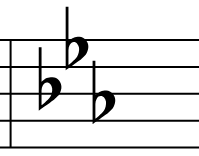
The key signature above contains three flats.
Applying the Dep-Bead rule gives the following sequence:
B♭ → E♭ → A♭
Now, take the last flat (A♭) as the reference point. In the BEAD direction, the key one step ahead is D♭, while the key one step behind is E♭.
Therefore, the major key of this piece is E♭ Major.
Finding Major Keys from Sharp Key Signatures
Now let’s learn how to identify the major key from a sharp key signature.
In the previous article, we explained sharp key signatures as follows:
“Starting from F#, the key signature includes every sharp up to two steps behind the target key in the DAEB direction.”
In this article, we will apply this rule in reverse.
In other words,
The major key is the key located two steps ahead of the last sharp in the DAEB direction.
Let’s look at the example below.
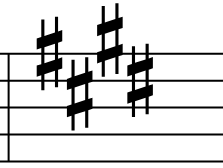
The key signature above contains four sharps.
Applying the Dep-Bead rule gives the following sequence:
F# → C# → G# → D#
Now, take the last sharp (D#) as the reference point. In the DAEB direction, the key one step ahead is A, and the key two steps ahead is E.
Therefore, the major key of this piece is E Major.
Conclusion
In this article, we applied the Dep-Bead Theory to identify the major key simply by looking at the key signature.
There is no need to learn another memorization technique. By simply applying the Dep-Bead rule in reverse, you can quickly determine the major key.
As you read more sheet music, you’ll eventually recognize the major key the moment you see the key signature. At first, practice with the examples in this article, then reinforce your understanding by working with real sheet music or online key signature quizzes.
Below is a link to a website where you can practice identifying major keys from key signatures.