Introduction
Key signatures are one of the most important concepts in music. Although I am not a professional musician, I enjoy playing the guitar as a hobby. As I tried to gain a deeper understanding of music, I eventually found myself facing the challenge of learning key signatures.
Most music theory books explain that you should simply memorize the order of sharps (F, C, G, D, A, E, B) and flats (B, E, A, D, G, C, F). However, memorization alone is easy to forget over time.
So I began to wonder:
“Is there a way to find key signatures without memorizing them?”
While exploring this question, I realized that the Circle of Fifths can be used to derive key signatures naturally.
In this article, I’d like to introduce a simple method I organized for finding key signatures using the Circle of Fifths.
Dep-Bead Theory
The BEAD and DAEB directions used in this article are based on the Dep-Bead Theory, which I introduced in a previous article.
Although the theory is explained in detail there, here is a brief overview.
Dep stands for DAEB.
As the name suggests, DAEB represents the direction in which musical tension gradually increases. Musically, moving clockwise around the Circle of Fifths tends to create a brighter sense of tonal movement.
The DAEB direction starts from C and proceeds by ascending perfect fifths:
C → G → D → A → E → B → F♯ → C♯
Bead stands for BEAD.
Starting from C, it proceeds by descending perfect fourths:
C → F → B♭ → E♭ → A♭ → D♭ → G♭ → C♭
This direction represents the gradual release of tension. The sequence also connects naturally when remembered using the acronym BEAD.
The following article explains the Dep-Bead Theory in detail.
Dep–Bead Theory: A New Emotional Model of the Circle of Fifths
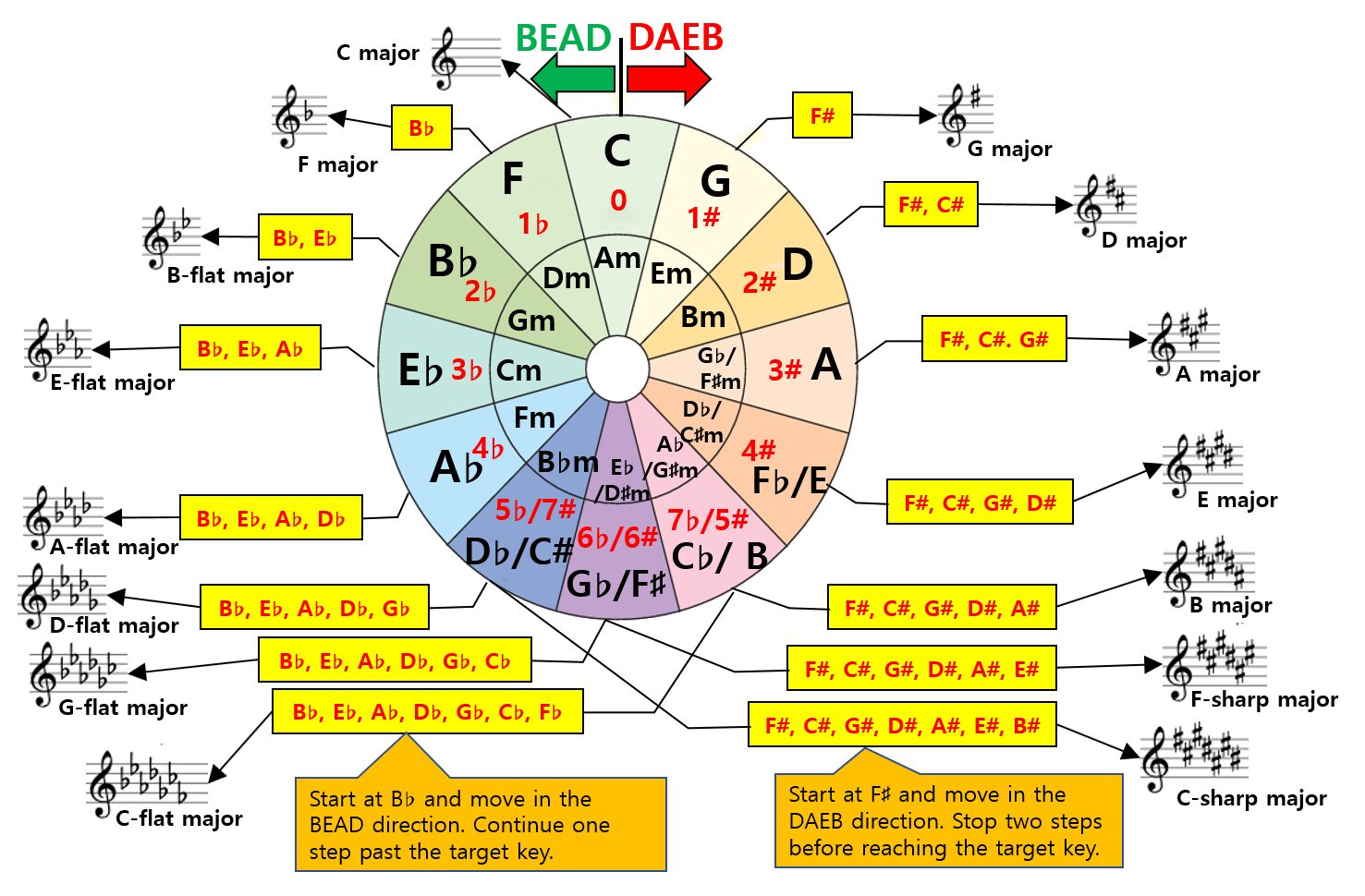
The figure below illustrates the Circle of Fifths based on the Dep-Bead Theory.
It also includes the rules introduced in this article for finding flat and sharp key signatures using the Circle of Fifths.
Finding Flat Key Signatures with the Circle of Fifths
Flats are arranged counterclockwise around the Circle of Fifths, following the BEAD direction in descending perfect fourths.
The rule for finding flat key signatures is very simple.
Start at B♭ and move in the BEAD direction. Continue one step past the target key.
Let’s apply this rule to each major key.
- F major continues one step to B♭, so its key signature is B♭.
- B♭ major continues one more step to E♭, so its key signature is B♭, E♭.
- E♭ major continues one more step to A♭, so its key signature is B♭, E♭, A♭.
- A♭ major continues one more step to D♭, so its key signature is B♭, E♭, A♭, D♭.
- D♭ major continues one more step to G♭, so its key signature is B♭, E♭, A♭, D♭, G♭.
- G♭ major continues one more step to C♭, so its key signature is B♭, E♭, A♭, D♭, G♭, C♭.
- C♭ major continues one more step to F♭, so its key signature is B♭, E♭, A♭, D♭, G♭, C♭, F♭.
As you can see, simply start at B♭ and follow the BEAD direction until one step past the target key. Using this simple rule, you can determine the key signatures of all flat major keys without memorizing them. One of the greatest advantages of this method is that the Circle of Fifths alone is enough to derive every flat key signature.
Writing Flat Key Signatures on the Staff
As explained above, flat key signatures are added in the following order:
B♭ → E♭ → A♭ → D♭ → G♭ → C♭ → F♭
This is not simply an order to memorize. It is the exact order in which flat key signatures are written on the musical staff.
For example, the key signature of C♭ major, which contains seven flats, is:
B♭, E♭, A♭, D♭, G♭, C♭, F♭
As shown in the figure below, each flat symbol is placed on the staff line or space corresponding to its note. In other words, a key signature is not just a list of accidentals—it tells the performer that specific notes should always be played one semitone lower throughout the piece.
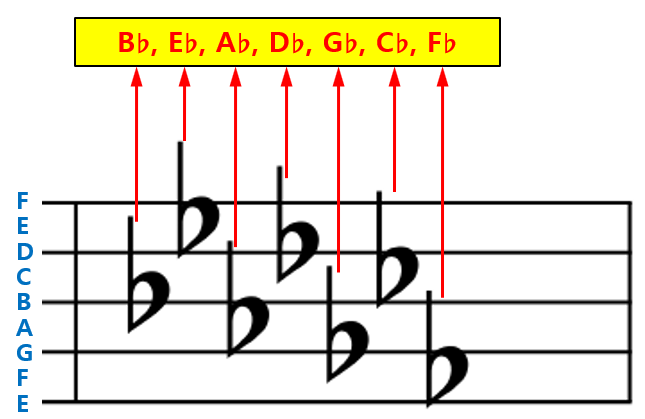
Therefore, in C♭ major, whenever the notes B, E, A, D, G, C, and F appear in the music, they are played as
B♭, E♭, A♭, D♭, G♭, C♭, F♭
respectively.
This makes it easy to see how the key signatures derived from the Circle of Fifths correspond directly to the key signatures written on the musical staff.
Finding Sharp Key Signatures with the Circle of Fifths
Sharps are arranged clockwise around the Circle of Fifths, following the DAEB direction in ascending perfect fifths.
The rule for finding sharp key signatures is just as simple.
Start at F♯ and move in the DAEB direction. Stop two steps before reaching the target key.
Let’s apply this rule to each major key.
- G major stops two steps before reaching G, so its key signature is F♯.
- D major continues one more step to C♯, so its key signature is F♯, C♯.
- A major continues one more step to G♯, so its key signature is F♯, C♯, G♯.
- E major continues one more step to D♯, so its key signature is F♯, C♯, G♯, D♯.
- B major continues one more step to A♯, so its key signature is F♯, C♯, G♯, D♯, A♯.
- F♯ major continues one more step to E♯, so its key signature is F♯, C♯, G♯, D♯, A♯, E♯.
- C♯ major finally continues one more step to B♯, so its key signature is F♯, C♯, G♯, D♯, A♯, E♯, B♯.
As you can see, simply start at F♯ and follow the DAEB direction until two steps before reaching the target key. Just like the flat keys, you can determine the key signatures of all sharp major keys without memorizing them. The Circle of Fifths alone is enough to derive every sharp key signature.
Writing Sharp Key Signatures on the Staff
As explained above, sharp key signatures are added in the following order:
F♯ → C♯ → G♯ → D♯ → A♯ → E♯ → B♯
This is not simply an order to memorize. It is the exact order in which sharp key signatures are written on the musical staff.
For example, the key signature of C♯ major, which contains seven sharps, is:
F♯, C♯, G♯, D♯, A♯, E♯, B♯
As shown in the figure below, each sharp symbol is placed on the staff line or space corresponding to its note. In other words, a key signature is not just a list of accidentals—it tells the performer that specific notes should always be played one semitone higher throughout the piece.
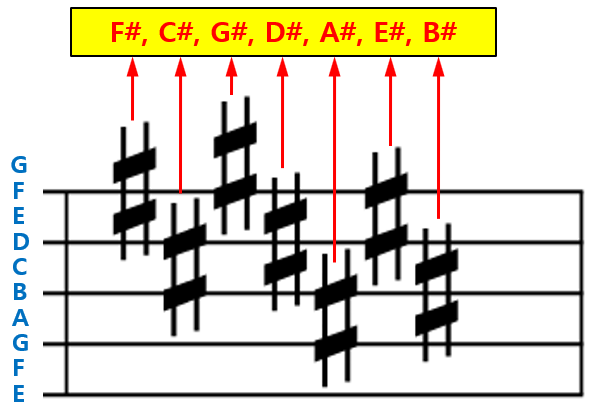
Therefore, in C♯ major, whenever the notes F, C, G, D, A, E, and B appear in the music, they are played as
F♯, C♯, G♯, D♯, A♯, E♯, B♯
respectively.
This makes it easy to see where sharp key signatures are written on the musical staff and why they always follow the order
F♯ → C♯ → G♯ → D♯ → A♯ → E♯ → B♯.
Conclusion
Key signatures are one of the fundamental concepts every musician encounters when learning music. Most music theory books teach the order of sharps and flats as something to memorize, but memorized information is often forgotten over time.
In this article, we explored a simpler way to find key signatures using the Circle of Fifths.
By understanding just two simple rules—start at B♭ and continue one step past the target key in the BEAD direction for flat keys, and start at F♯ and stop two steps before reaching the target key in the DAEB direction for sharp keys—you can determine the key signatures of all major keys using only the Circle of Fifths, without relying on memorization.
Of course, memorization is one way to learn key signatures. However, once you understand the underlying principle of the Circle of Fifths, key signatures become something you can derive naturally rather than something you must memorize. One advantage of this approach is that it is much easier to remember over time.
The method introduced in this article is not a new music theory. Rather, it is a learning method that I organized to make key signatures easier to understand and derive using the Circle of Fifths. I have personally found this approach much easier for understanding and remembering key signatures.
The Circle of Fifths is useful for much more than key signatures. It is also a valuable tool for understanding diatonic chords, modulation, chord progressions, and many other areas of music theory. I hope this article helps you become more familiar with the Circle of Fifths and discover another practical way to use it.





“How to Find Key Signatures Without Memorizing Them”에 대한 1개의 생각