Overview
To play guitar, the first thing you need to learn is how to play basic guitar chords.
This may sound obvious, but without a systematic approach, it is surprisingly difficult to memorize chords beyond just a few common ones.
When I first started learning guitar, I could only play a small number of chords as well. Because of that, I spent a lot of time searching the internet and watching YouTube videos to find easier ways to memorize guitar chords.
This article is based on notes and ideas I personally organized while studying guitar. I wrote it to share practical ways to overcome the difficulty of memorizing guitar chords.
Core Principles for Memorizing Guitar Chords Easily
To achieve anything, you need at least a basic level of foundational knowledge.
Learning guitar is not the hardest thing in the world, but like any skill, it is difficult to reach your goal without consistent effort and dedication.
Of course, that does not mean playing guitar itself is a trivial task.
Whenever I watch people perform guitar naturally and effortlessly, I am reminded of how much practice and persistence must have gone into their playing, and I cannot help but feel respect for their effort.
In this article, guitar-related terms are written mainly in English.
Not only are guitar chords themselves commonly expressed using English notation, but most related materials are also written in English.
Because of that, becoming familiar with English guitar terminology will help you understand and use a much wider range of learning resources.
Among the music theory concepts many people learn as children, there is something called the musical scale.
In some countries, notes are commonly sung as Do, Re, Mi, Fa, Sol, La, Si, Do.
However, these terms are not originally Korean or English expressions. They originated from Italian musical terminology.
If expressed using traditional Korean note names, it would sound something like “Goong-Sang-Gak-Chi-Woo.”
In this article, we will use:
C D E F G A B C
Below are some of the basic concepts that will help you understand and memorize guitar chords more easily.
Understanding the Structure of Notes on the Fretboard
The diagram below shows the notes on each string of the guitar fretboard.
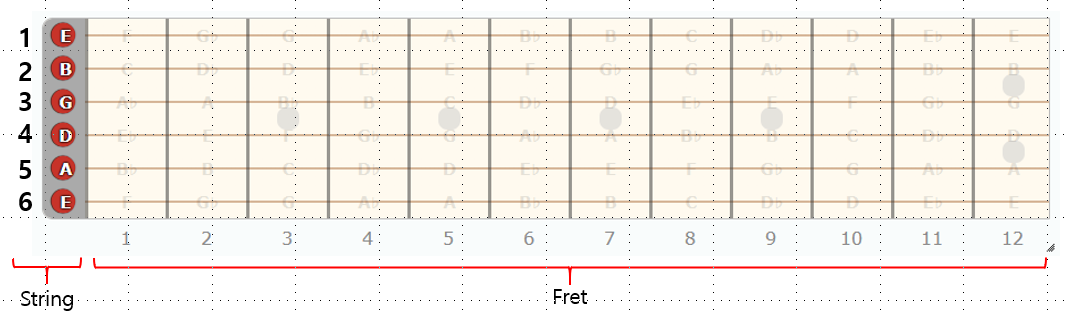
The 6th string is the thickest string on the guitar and is tuned to E
(Low E string, E2, 82.4Hz).
In this article, we will refer to it as the Low E string.
It produces the lowest pitch on the guitar and often plays the role of the bass.
The 5th string is the second thickest string and is tuned to A
(A string, A2, 110Hz).
In this article, we will refer to it as the A string.
It is frequently used as the root note when playing chords and often serves as an important center tone.
The 4th string is a medium-sized string tuned to D
(D string, D3, 146.8Hz).
In this article, we will refer to it as the D string.
It commonly functions as a middle tone and is frequently used in rhythm strumming and chord construction.
The 3rd string is a slightly thinner string tuned to G
(G string, G3, 196Hz).
In this article, we will refer to it as the G string.
It is often used for melodies and arpeggios.
The 2nd string is a relatively thin string tuned to B
(B string, B3, 246.9Hz).
In this article, we will refer to it as the B string.
It helps create bright chord tones and higher melodic sounds.
The 1st string is the thinnest string on the guitar and is tuned to E
(High E string, E4, 329.6Hz).
In this article, we will refer to it as the High E string.
It is most commonly used for melodies and guitar solos.
Acoustic guitars typically have 20 frets.
Electric guitars usually have between 21 and 24 frets, depending on the manufacturer and model.
Classical guitars commonly have 19 frets.
Understanding which note appears at each fret position on each string is very important for learning guitar chords.
In this article, we will focus mainly on the Low E string and the A string.
This is because these two strings are responsible for the root notes of many guitar chords.
In other words, the 6th string (Low E string) and the 5th string (A string) often determine the foundational tone of a chord.
By understanding the note layout of these two strings, you can understand chord structures much more easily.
Unlike open chords, barre chords do not rely on open strings.
As a result, simply moving the hand position allows the same chord shape to be used in different keys.
The two most common barre chord forms are the E shape and the A shape.
Although all five CAGED shapes (C, A, G, E, and D) can be used as movable chord forms, this article focuses primarily on the E shape and A shape because they make it easier to locate the root note.
In other words, a barre chord can be viewed as a movable version of an open chord.
Understanding this relationship systematically is one of the core ideas behind the CAGED System.
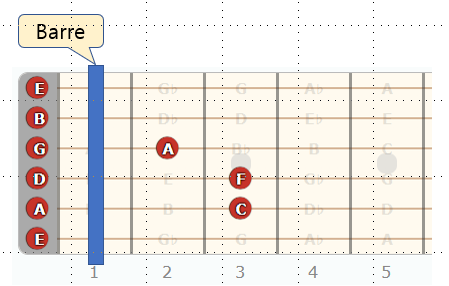
One of the most common examples of a barre chord is the F major chord.
The F major chord is created by moving the open E major shape up one fret while using the index finger as a barre.
For many guitarists, the F major chord serves as the starting point for learning barre chords and understanding movable chord shapes.
Understanding Chord Relationships Through the CAGED System
The CAGED System is a structured method for understanding the guitar fretboard through five fundamental chord shapes:
C – A – G – E – D
The name CAGED comes directly from the first letters of these five chord forms.
Its purpose is to help guitarists understand the entire fretboard as a connected system rather than a collection of isolated chord shapes.
When each open chord shape is converted into a movable barre chord and shifted along the neck, the five forms become interconnected.
As a result, a single chord—for example, a C major chord—can be found in five different positions corresponding to the C, A, G, E, and D shapes.
These forms overlap and connect with one another across the fretboard, creating a visual map of chord tones and note locations.
This interconnected relationship is the essence of the CAGED System.
When I was learning the CAGED System, I found the explanation in the following article particularly helpful.
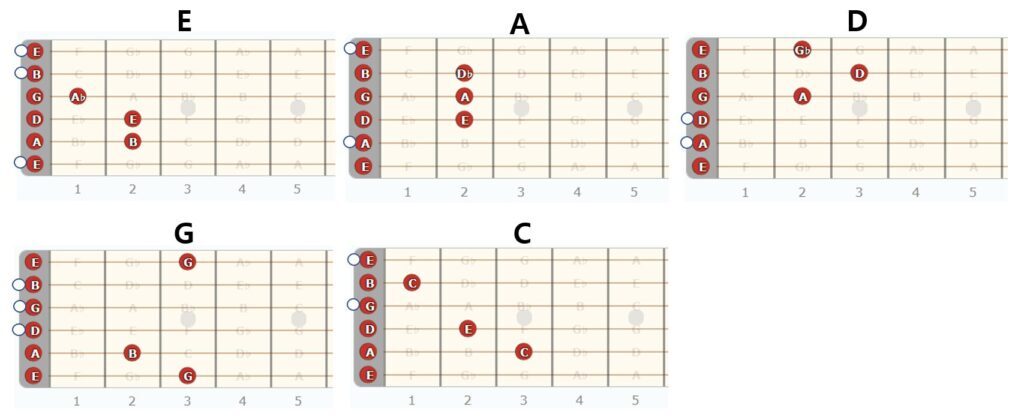
The diagram shown below is adapted from that reference and illustrates how an E-shape chord changes as it moves up the fretboard.
Reference: Yurang Guitar – CAGED System Guide)
The diagram below, taken from the website referenced above, shows how an E-shape chord changes into different chords as it is moved to different fret positions.
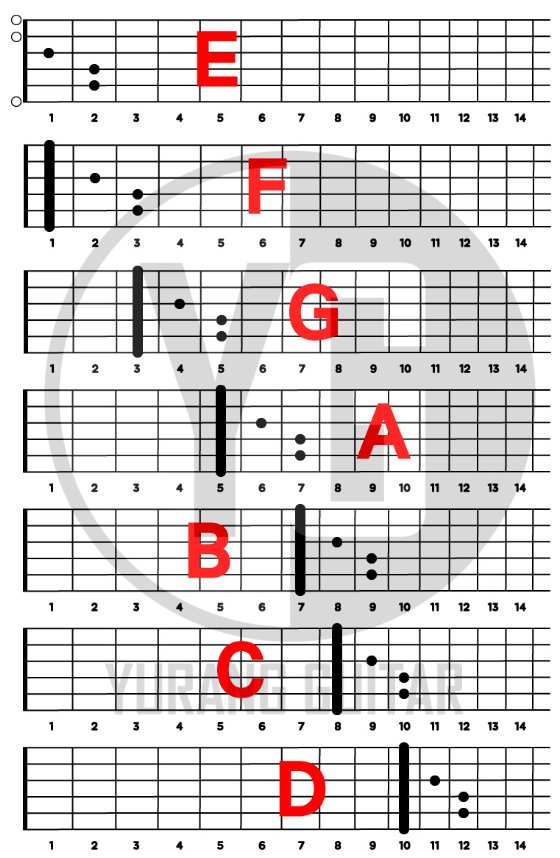
The diagram above shows how an E-shape chord changes into different chords as it is moved to different fret positions:
E → F → G → A → B → C → D
This demonstrates that a large portion of the fretboard can be understood by learning just a single chord shape—in this case, the E shape.
In the same way, all of the open chord forms used in the CAGED System:
- C Shape
- A Shape
- G Shape
- E Shape
- D Shape
can be moved along the fretboard and transposed into chords in different keys.
Therefore, by understanding the CAGED System, you can develop a logical understanding of how chords and scales are connected across the entire fretboard.
Rather than seeing the guitar neck as a collection of unrelated chord diagrams, you begin to recognize it as a connected musical framework where chord shapes, root notes, and scales are all linked together.
How to Memorize Guitar Chords More Easily
Now that we have covered the basic concepts, let’s move on to the main topic of this article: how to memorize guitar chords more effectively.
Learning Chord Shapes
In this article, we will build and understand chords primarily from the perspective of the E string (6th string) and A string (5th string).
A chord shape is determined by the string that contains the chord’s root note.
In other words:
- Chords with their root note on the E string use the E Shape.
- Chords with their root note on the A string use the A Shape.
These two forms (E Shape and A Shape) are the most practical starting points for learning chords because they are structurally simple and directly reflect the core concepts of the CAGED System.
For this reason, they are often the easiest chord forms to understand, visualize, and memorize.
Understanding Chords Through Root Notes
Every chord begins with a root note.
In fact, the name of a chord is determined by the position of its root note.
For example, if the root note is C, the chord is some form of a C chord. If the root note is G, the chord becomes some form of a G chord.
Therefore, locating the root note is often the fastest way to identify and memorize a chord.
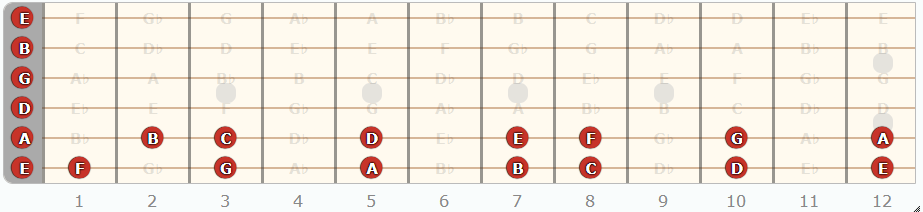
The diagrams below show the root-note positions on the E string and A string.
Once these root notes become familiar, finding and remembering chord positions across the fretboard becomes much easier.
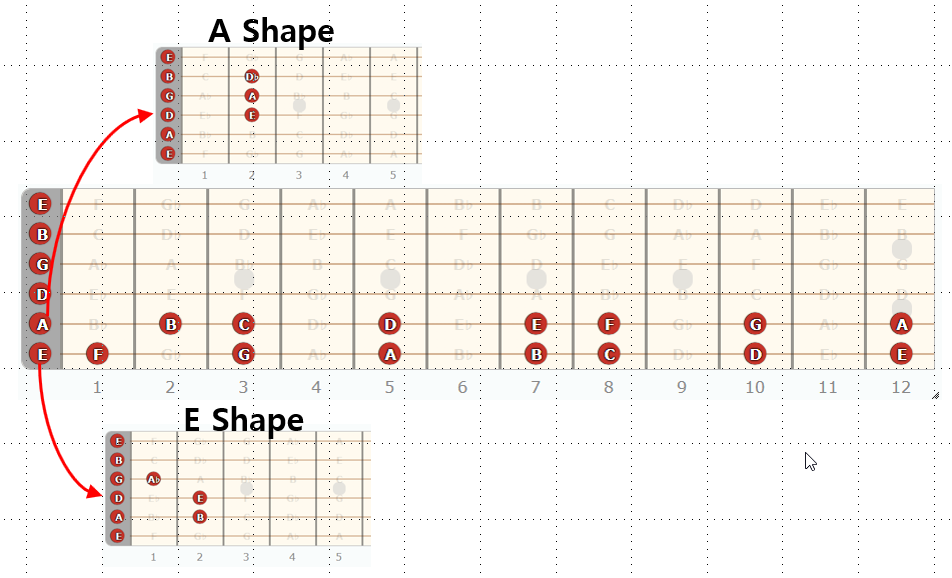
As shown in the diagram above, the notes on the E string (6th string) progress in the following order starting from the open string:
E → F → G → A → B → C → D → E
In other words, by moving through a combination of half steps and whole steps, you eventually reach the next octave.
Because of this, once you know the root note on the E string, you can create many different chords using the same chord shape.
For example:
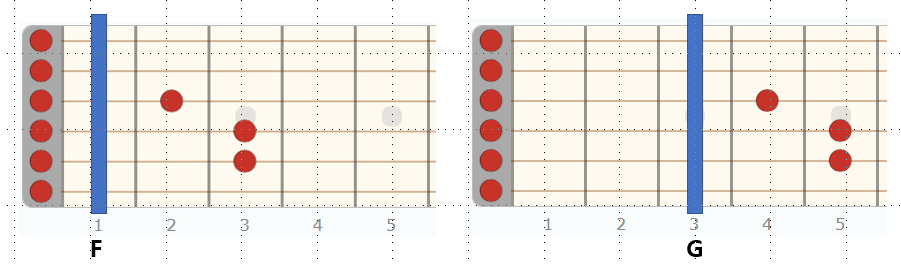
- An F chord (F major) is created by placing a barre at the 1st fret, where the root note is F, and then applying the standard E-shape chord form.
- A G chord (G major) is created by placing a barre at the 3rd fret, where the root note is G, while keeping the same E-shape form.
The important point is that the shape remains the same.
Only the position of the barre changes, allowing the chord to be transposed to a different key.
The diagrams below show examples of F major and G major chords using the E-shape barre chord form.
A-shape barre chords are chord forms built with the 5th string (A string) as the root note.
In this case, the note on the 5th string determines the name of the chord. By keeping the same chord shape and simply moving the barre to a different fret, you can play the chord in different keys.
Starting from the open A string, the notes progress as follows:
A → B → C → D → E → F → G → A
As with the E string, moving through a combination of half steps and whole steps eventually completes an octave.
Therefore:
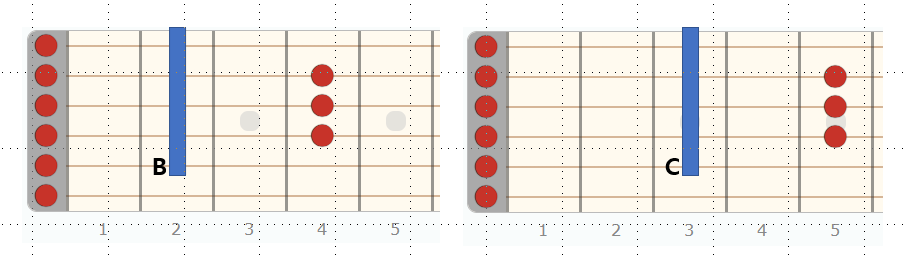
- A B chord (B major) is formed by placing a barre at the 2nd fret, where the root note is B, and then applying the standard A-shape chord form.
- A C chord (C major) is formed by placing a barre at the 3rd fret, where the root note is C, while keeping the same A-shape form.
The key idea is that the chord shape remains unchanged.
Only the position of the barre moves, changing the root note and therefore the name of the chord.
The diagrams below show examples of B major and C major chords using the A-shape barre chord form.
Conclusion
Everything we have discussed so far has focused not on memorizing guitar chords as isolated finger patterns, but on understanding the principles and structure behind them.
In particular, once you understand the CAGED System, especially through the E Shape and A Shape, the guitar fretboard begins to appear as a connected map rather than a collection of unrelated chord diagrams.
Ultimately, memorizing chords is not about repeatedly memorizing finger positions.
It is about understanding the relationship between the root note and the corresponding chord shape.
If you can clearly recognize these two elements—Root Note and Shape—you will be able to locate and build chords anywhere on the fretboard.
That is the real meaning behind the phrase:
“How to Memorize Guitar Chords Easily.”
Rather than memorizing hundreds of individual chord diagrams, you learn the underlying pattern that connects them all.
Note: All chord diagrams used in this article were created with Guitar Scientist Editor.
https://www.editor.guitarscientist.com/
This tool is a convenient way to create guitar chord charts and fretboard diagrams for educational purposes.







My family all the time say that I am wasting my time here at net, except I know I am getting experience every day by
reading such good content.